



If your teen has always been “all over the place,” you’ve probably heard it explained a dozen different ways — lazy, unmotivated, a phase, just a teenager. But if missed assignments, lost belongings, and half-finished projects have been a pattern since childhood, and it’s starting to affect school, friendships, or your relationship at home, ADHD may be part of the picture.
Attention-Deficit/Hyperactivity Disorder (ADHD) is one of the most commonly diagnosed conditions in adolescence, and while it begins in childhood, it doesn’t always look the same as a teen gets older. Understanding what’s changed — and what your options are — is the first step toward figuring out what your teen actually needs.
What Is ADHD in Teens?
According to the National Institute of Mental Health, ADHD is a developmental disorder marked by an ongoing pattern of inattention, hyperactivity, and impulsivity that interferes with daily functioning. Symptoms must begin before age 12, but they can look different by the time a child reaches adolescence.
ADHD is also one of several conditions we cover as part of our ongoing series on adolescent mental health — you can read our related article on Oppositional Defiant Disorder (ODD) in Teens for a look at another commonly co-occurring condition.
Younger kids with ADHD are often visibly hyperactive — running, climbing, unable to sit still. By the teen years, that outward hyperactivity tends to settle into something quieter but no less disruptive: inner restlessness, fidgeting, trouble following through, and a kind of chronic disorganization that can look like a motivation problem when it’s actually a brain-based difference in executive functioning.
Common Signs of ADHD in Teens
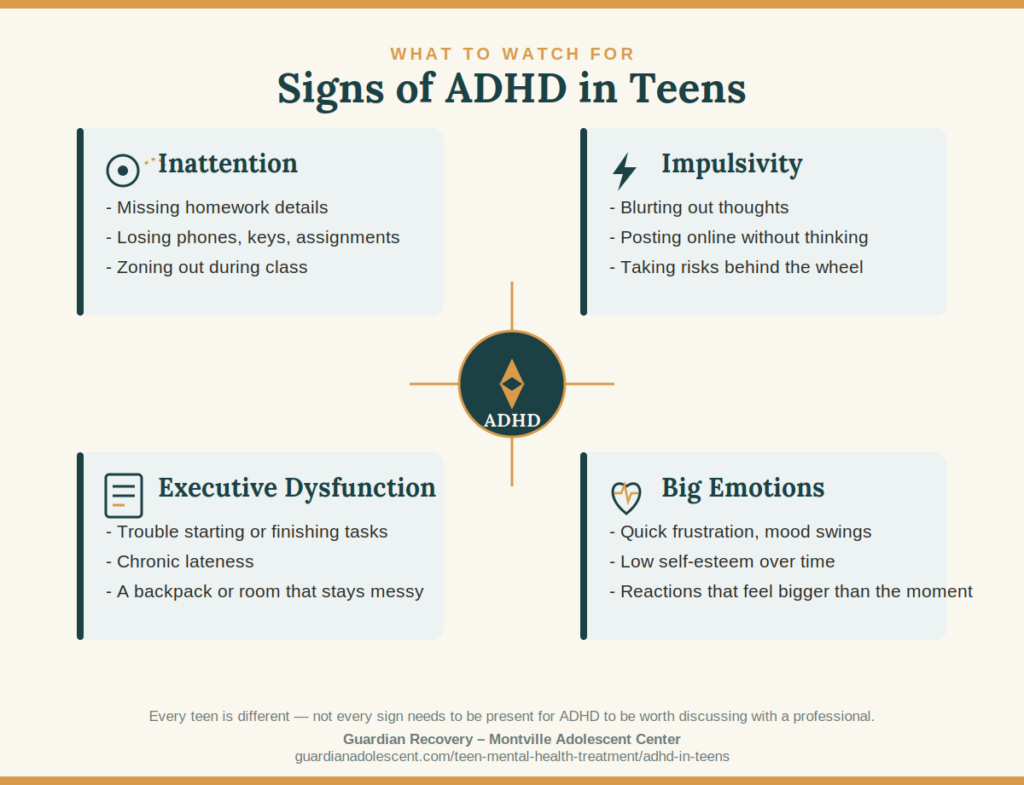
Signs can show up differently from teen to teen, but a few patterns are especially common:
- Inattention — missing homework details, zoning out in class, losing phones, keys, and assignments repeatedly
- Impulsivity — blurting things out, posting without thinking it through, taking risks behind the wheel
- Executive dysfunction — trouble starting or finishing projects, chronic lateness, a bedroom or backpack that never stays organized no matter how many times they try
- Big emotions — quick frustration, mood swings, and a self-esteem that’s taken a hit from years of being told to “try harder”
ADHD in Teen Girls Often Looks Different
ADHD in girls is frequently missed or diagnosed later than in boys, largely because it tends to show up as inattentiveness rather than the more visible hyperactivity teachers and parents associate with ADHD. A teen girl with ADHD may seem quiet, daydreamy, or anxious rather than disruptive — and because she isn’t causing a classroom disturbance, the underlying attention difficulty can go unrecognized for years, sometimes mistaken for anxiety or a mood issue instead.
ADHD and Teen Driving
This is one area where ADHD’s impact on teens is especially concrete. A study published in the journal Pediatrics by researchers at Children’s Hospital of Philadelphia found that newly licensed teen drivers with ADHD were significantly more likely to crash and receive traffic violations than their peers — including higher rates of speeding, seatbelt non-use, and driving while intoxicated.
This isn’t a reason to panic, but it is a reason to be intentional: talk openly with your teen about driving, consider a longer supervised-practice period, and know that treatment — medication in particular — has been shown to meaningfully improve driving safety in teens with ADHD.
School Accommodations: 504 Plans and IEPs
ADHD can qualify a student for school-based support, and understanding the options can save a lot of frustration:
- 504 Plan — provides accommodations like extended test time, preferential seating, or reduced-distraction environments. It doesn’t change what’s being taught, just how your teen accesses it.
- IEP (Individualized Education Program) — a more comprehensive option for teens whose ADHD significantly impacts learning, which can include specialized instruction in addition to accommodations.
If your teen is struggling academically, it’s worth requesting an evaluation through their school — this is a separate process from a clinical ADHD diagnosis, though the two often go hand in hand.
What Causes ADHD?
Researchers don’t point to a single cause. Current research from NIMH suggests ADHD likely results from an interaction between genetics and environmental factors — it is not caused by poor parenting, too much screen time, or a lack of discipline, despite how often those explanations get offered.
How ADHD Is Diagnosed
There’s no single test for ADHD. A proper evaluation typically involves a mental health professional gathering information from multiple sources — parent and teacher input, behavior history going back to childhood, and a clinical interview — since symptoms need to be present in more than one setting (school and home, for example) to point to ADHD rather than something situational.
When ADHD Overlaps with Anxiety, Depression, or Trauma
ADHD rarely travels alone. It’s common for teens with ADHD to also experience anxiety or depression — sometimes because living with unmanaged ADHD symptoms for years takes a real toll on self-esteem and stress levels, and sometimes because the conditions share some underlying brain-based factors. Past trauma can also complicate the picture, since trauma responses and ADHD symptoms can look similar on the surface but call for different treatment approaches.
If your teen’s picture includes both attention difficulties and significant worry, low mood, withdrawal, or a history of trauma, it’s worth having everything evaluated together rather than treating one piece in isolation. We cover this in more depth in our teen anxiety and teen depression resources, including our full article on Depression in Teens.
Treatment Options for Teen ADHD
Most effective treatment plans combine more than one approach:
- Behavioral therapy and individual counseling — helps teens build organizational systems, coping strategies, and self-advocacy skills
- Medication — stimulant and non-stimulant options can meaningfully reduce core symptoms for many teens, though it’s a decision to make with a prescriber based on your teen’s specific needs
- Family involvement — parent coaching and family therapy help translate strategies from a therapist’s office into daily life at home
- School coordination — aligning accommodations (504/IEP) with outside treatment so your teen isn’t managing two disconnected systems
For teens who need more consistent structure than weekly therapy provides, our Teen Mental Health IOP offers a higher level of support while your teen stays connected to school and home.
Who We Are
Guardian Recovery – Montville Adolescent Center is a teen mental health treatment program based in Towaco, NJ, built specifically around adolescent development rather than adapted from adult-focused care. Our clinical team works with families across New Jersey to address ADHD alongside anxiety, depression, trauma, and other conditions that often show up together — through individual therapy, family involvement, and, when it’s the right fit, a more structured level of care like our IOP. If you’re trying to figure out what kind of support your teen actually needs, our team is a good place to start that conversation, whether or not Guardian Recovery ends up being the right fit.
| Don’t Live in New Jersey?
Guardian Recovery –Montville Adolescent Center also offers a Teen Virtual Counseling Program for families outside New Jersey. Wherever you are, our clinical team can provide support, guidance, and a next-steps assessment. |
When to Seek Help
If ADHD symptoms are creating real friction — falling grades, family conflict, a teen who feels like they’re failing no matter how hard they try — it’s worth having a conversation with a pediatrician or mental health professional. And if ADHD is showing up alongside other concerns, like significant anxiety, depression, or risky behavior, a more comprehensive evaluation can help make sure nothing is being missed.
Guardian Recovery – Montville Adolescent Center provides mental health treatment for teens, including support for ADHD and co-occurring conditions. Call (888) 343-3505 to talk with our team about what support might look like for your family.
Frequently Asked Questions
What are the signs of ADHD in a teenager?
The most common signs include ongoing inattention (missed details, losing things, trouble following through), impulsivity, difficulty with organization and planning, and emotional reactivity. Because hyperactivity tends to look different in teens than in younger kids — more inner restlessness than visible activity — it’s often the inattentive and disorganized symptoms that stand out most.
What does ADHD look like in a 15-year-old?
At 15, ADHD often shows up as academic struggles that don’t match a teen’s intelligence or effort — forgetting assignments, losing track of time, difficulty managing a more demanding class schedule — along with impulsive decisions and friction at home over follow-through on responsibilities.
How can I help my teen with ADHD without medication?
Medication is one option, not a requirement. Structured routines, written checklists instead of relying on memory, consistent sleep and exercise, and behavioral therapy that builds organizational skills can all meaningfully help — often in combination with, rather than instead of, other supports your teen’s provider recommends.
Do supplements or diet changes help with ADHD symptoms?
Some families find that consistent, balanced meals and adequate sleep support overall symptom management, which lines up with general guidance from NIMH on healthy routines. There isn’t strong evidence that any specific supplement treats ADHD on its own, so it’s worth talking with your teen’s doctor before adding anything, rather than relying on a supplement in place of an evaluated treatment plan.