



Every teenager worries sometimes — about a test, a friendship, what happens after high school. But if the worry never really lets up, jumps from one thing to the next, and comes with headaches, stomachaches, or trouble sleeping, it may be more than typical teen stress. Generalized Anxiety Disorder (GAD) is one of the most common mental health conditions in adolescence, and it’s also one of the most often missed, because constant worry can look a lot like a personality trait rather than something treatable.
What Is GAD in Teens?
According to Cedars-Sinai, GAD involves excessive, hard-to-control worry that shows up on most days for six months or more — not just occasional nervousness, but a pattern that interferes with school, friendships, and daily functioning.
GAD is also one of several conditions we’re covering in our ongoing series on adolescent mental health. If ADHD or defiant behavior sounds more like what you’re seeing, our articles on ADHD in Teens and Oppositional Defiant Disorder (ODD) in Teens may be a better starting point.
Common Signs of GAD in Teens
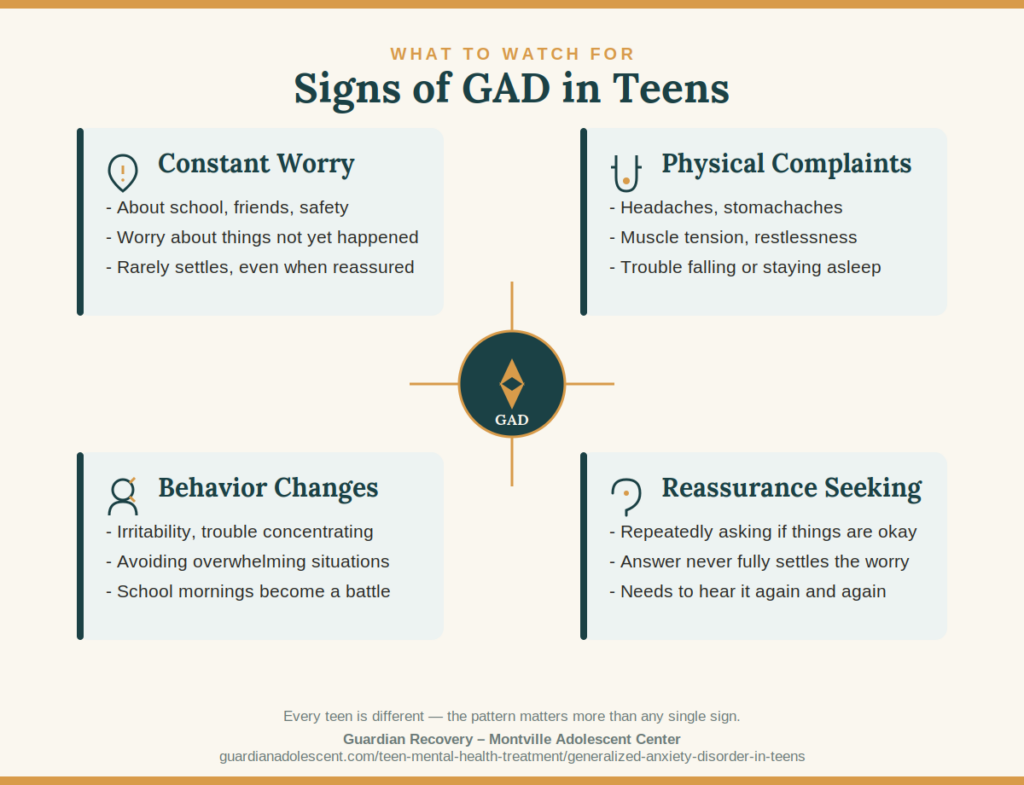
- Constant worry — about school performance, friendships, family safety, or things that haven’t happened yet
- Physical complaints — frequent headaches, stomachaches, muscle tension, or trouble sleeping
- Behavior changes — irritability, trouble concentrating, or avoiding situations altogether
- Reassurance seeking — repeatedly asking if things will be okay, even after being told they are
When Worry Turns Into School Avoidance
One of the clearest ways GAD shows up in teens is around school — not just test anxiety, but a broader dread that can build into avoidance or refusal to attend altogether. Stanford Medicine Children’s Health lists refusal to go to school among the common symptoms of GAD, alongside the physical complaints that often accompany it.
If mornings have become a battle, or your teen frequently asks to stay home for reasons that don’t quite add up, it’s worth considering whether anxiety — rather than defiance or laziness — is the real driver.
GAD in Teen Girls
GAD tends to emerge around puberty and is diagnosed more often in girls than in boys, according to Mount Sinai, affecting an estimated 2 to 6 percent of children and teens overall. Because girls are also more likely to internalize their anxiety — appearing quiet, compliant, or overly perfectionistic rather than visibly distressed — it can take longer for the underlying worry to be recognized as something more than a personality trait.
Normal Worry vs. GAD
All teens worry — about grades, friendships, what comes after high school. The difference with GAD isn’t the topic, it’s the pattern: the worry shows up on most days, lasts six months or more, and doesn’t ease up even when there’s no real problem to solve. A teen with typical stress can usually be reassured and move on. A teen with GAD often can’t, even when they know, logically, that the worry doesn’t quite add up.
How to Respond When Your Teen Is Anxious
- Acknowledge the worry instead of dismissing it — “that sounds really stressful” lands better than “you don’t need to worry about that”
- Resist over-reassuring — answering the same worry repeatedly can accidentally reinforce it rather than ease it
- Keep routines predictable — consistent sleep, meals, and schedules give an anxious brain fewer unknowns to fill in
- Model calm, not panic — teens pick up on how the adults around them handle uncertainty
- Know when it’s beyond what home support can manage — that’s when it’s time to bring in a professional
What Causes GAD?
There’s no single cause. Most clinicians point to a combination of genetics, brain chemistry, and environment — a teen may inherit a tendency toward anxiety, and stressful events like a family loss, divorce, or ongoing family conflict can act as a trigger. A teen with a parent who has an anxiety disorder is also more likely to develop one, whether through genetics, learned behavior, or both.
How GAD Is Diagnosed
There’s no lab test for GAD. Diagnosis typically comes from a comprehensive clinical evaluation — a mental health professional looking at how long the worry has lasted, how many areas of life it touches, and how much it’s interfering with school, sleep, or relationships. This is a conversation to have with a pediatrician or mental health provider, not something to work out from a list of symptoms alone.
When GAD Overlaps with Depression or ADHD
Anxiety and depression frequently travel together in teens, and untreated GAD can contribute to both depression and difficulty functioning at school over time. It’s also common for GAD to co-occur with ADHD, since the two can compound each other — a teen with ADHD may develop anxiety around falling behind, or an anxious teen may struggle to concentrate. If your teen’s picture includes both, it’s worth having them evaluated together. We cover this in more depth in our teen depression and ADHD in teens resources, as well as our dedicated guide on Depression in Teens.
Treatment Options for Teen GAD
Most effective treatment plans combine more than one approach:
- Cognitive Behavioral Therapy (CBT) — helps teens identify anxious thought patterns, understand what’s fueling them, and build practical coping skills to manage worry rather than be managed by it
- Individual therapy — gives teens a consistent space to work through specific worries with a therapist one-on-one
- Medication — antidepressants (including SSRIs) are commonly used for teen anxiety, prescribed cautiously and dosed appropriately for adolescents by a psychiatric provider
- Family involvement — parents play a central role in treatment, since how a family responds to a teen’s anxiety can either reinforce or ease it
- School coordination — looping in school staff, especially if avoidance or refusal has become part of the pattern
For teens who need more structure than weekly therapy alone provides, our Teen Mental Health IOP offers a higher level of support while your teen stays connected to school and home.
Who We Are
Guardian Recovery – Montville Adolescent Center is a teen mental health treatment program based in Towaco, NJ, built specifically around adolescent development. Our clinical team works with families across New Jersey to address GAD alongside depression, ADHD, and other conditions that often show up together — through individual therapy, family involvement, and, when it’s the right fit, a more structured level of care like our IOP. If you’re trying to figure out what kind of support your teen needs, our team is a good place to start that conversation, whether or not Guardian ends up being the right fit.
| Don’t Live in New Jersey?
Guardian Recovery –Montville Adolescent Center also offers a Teen Virtual Counseling Program for families outside New Jersey. Wherever you are, our clinical team can provide support, guidance, and a next-steps assessment. |
When to Seek Help
If worry has become a daily fixture in your teen’s life — disrupting sleep, school, or family time — it’s worth having a conversation with a pediatrician or mental health professional. GAD doesn’t resolve on its own, and teens with GAD aren’t able to simply talk themselves out of it, even when they know their worry doesn’t fully make sense.
Guardian Recovery – Montville Adolescent Center provides mental health treatment for teens, including support for GAD and co-occurring conditions. Call (888) 343-3505 to talk with our team about what support might look like for your family.
Frequently Asked Questions
Can a teen with GAD live a normal life?
Yes. With the right treatment — typically therapy, and sometimes medication — most teens with GAD see real improvement. Learning to manage anxious thoughts rather than be controlled by them is a skill, and it’s one that gets stronger with practice and support.
How do teens learn to live with GAD day to day?
Many teens manage GAD successfully by combining therapy-based coping strategies (like recognizing anxious thought patterns before they spiral) with consistent routines — regular sleep, exercise, and, when needed, medication. It’s rarely about eliminating worry completely, but about reducing its grip on daily life.
What medications are commonly used for GAD?
Antidepressants and anti-anxiety medications are the most commonly prescribed options, though the right choice depends on your teen’s specific symptoms and health history. This is a decision to make with a prescriber, not something to start or adjust on your own.
What are healthy coping strategies for teens with GAD?
Approaches that come up often include regular exercise, consistent sleep habits, mindfulness or relaxation techniques, and the specific coping skills a therapist teaches through CBT. These tend to work best alongside professional treatment, not as a replacement for it.